

Online Baccarat Guide: Live Dealer Odds & Road Tracking Math
⚡ Quick Direct Answer
Baccarat offers some of the highest mathematical player returns in the casino, with Banker bets featuring a 1.06% house edge and Player bets carrying 1.24%. Tie bets carry a punitive 14.36% house advantage and should be avoided.
Baccarat is the undisputed king of Asian casino tables, celebrated for its low house advantage and rapid decision speed. Whether streaming from Evolution Gaming or Sexy Baccarat studios, modern live dealer lobbies provide clear statistical roadmaps. Our independent desk audited mathematical shoe probabilities, drawing tableaus, and optimal staking discipline.

Mathematical House Edge & Probability Breakdown
Every hand dealt from an 8-deck shoe follows strict fixed drawing procedures. Neither the dealer nor the player makes subjective card choices, meaning mathematical probabilities remain stable throughout.
| Bet Selection | Statistical Win Probability | Standard Payout Ratio | Mathematical House Edge |
|---|---|---|---|
| Banker Bet | 45.86% (50.68% excluding ties) | 1:1 (minus 5% commission) | 1.06% (Lowest edge) |
| Player Bet | 44.62% (49.32% excluding ties) | 1:1 (Even money) | 1.24% (Strong return) |
| Tie Outcome | 9.52% | 8:1 | 14.36% (Extremely high edge) |
| Banker/Player Pair | 7.47% | 11:1 | 10.36% (High variance side bet) |
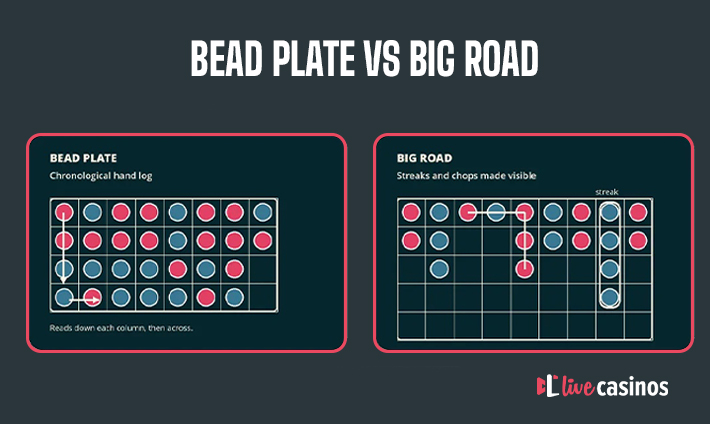
Understanding Score Roads: Bead Plate & Big Road
Baccarat interfaces feature detailed historical trend boards known as score roads. While roads cannot predict future random shuffles, they help players follow table rhythm.
- Bead Plate (Bead Road): Records exact chronological outcomes from top to bottom, with red for Banker, blue for Player, and green for Tie.
- Big Road: Organizes outcomes into vertical columns representing consecutive streaks, starting a new column whenever the winner changes.
- Derived Roads (Big Eye Boy, Small Road, Cockroach Pig): Track whether the shoe is repeating patterns (red) or displaying chaotic changes (blue).
Strategic Rule: Regardless of whether a shoe shows six consecutive Banker wins (the "Dragon streak"), the next hand retains the exact same 50.68% Banker win probability. Avoid increasing wagers beyond your preset unit size.

Standard Commission vs No Commission (Super 6) Baccarat
Many mobile live casino rooms offer No Commission Baccarat to eliminate fractional payout math. Understanding the mathematical trade-off reveals that standard 5% commission tables actually offer slightly superior returns.
| Rule Element | Standard Commission Baccarat | No Commission (Super 6) Baccarat |
|---|---|---|
| Regular Banker Win | Pays 0.95:1 (5% house commission deducted) | Pays 1:1 (Even money payout) |
| Banker Win on 6 Points | Pays 0.95:1 (Standard payout) | Pays 0.5:1 (Half payout penalty) |
| Effective Banker House Edge | 1.06% statistical advantage | 1.46% statistical advantage (Higher edge) |
| Recommended Table Type | Preferred for disciplined mathematical play | Preferred for fast-paced casual rounds |
Third Card Tableau Drawing Rules
The automatic third-card rule determines whether either side receives an extra card. Reviewing the tableau ensures you understand why dealers draw without human discretion.
- Natural Hands: If either Player or Banker has an 8 or 9 from the first two cards, both stand automatically.
- Player Rule: Player stands on 6 or 7. Player draws a third card on 0 through 5.
- Banker Rule: If Player stands, Banker follows the same 0-5 draw rule. If Player draws, Banker follows the mandatory third-card tableau.
Frequently Asked Questions About Baccarat
What is the mathematically best bet to place in Baccarat?
Direct Answer
The Banker bet is statistically superior with a 1.06% house edge, winning 45.86% of all non-tie hands compared to 44.62% for Player. Even with a 5% commission, Banker delivers the highest long-term return.
Why should players avoid betting on the Tie outcome in Baccarat?
Direct Answer
Tie bets carry an enormous 14.36% house advantage on 8:1 payouts. Although the payout appears generous, Tie outcomes only occur approximately 9.52% of the time, causing rapid mathematical bankroll depletion.
How do baccarat score roads like the Big Road work?
Direct Answer
Score roads record historical winning streaks using red (Banker) and blue (Player) markers. While useful for spotting visual streaks, each newly dealt round remains mathematically independent with fixed odds.
What is the difference between standard and No Commission Baccarat?
Direct Answer
In No Commission (Super 6) tables, winning Banker bets pay even money (1:1), but if the Banker wins with a point total of 6, the payout drops to 50% (0.5:1), giving a 1.46% house edge.
When does the Banker hand draw a mandatory third card?
Direct Answer
The Banker draws a third card based on a strict tableau depending on the Player third card value. For example, if Banker has 3, it always draws unless the Player third card was an 8.
Advanced Card Reading: The Derived Roads Explained
Beyond the standard Big Road, experienced baccarat players consult three derived roads: Big Eye Boy, Small Road, and Cockroach Pig. These specialized trend charts evaluate whether the current shoe is exhibiting consistency or chaotic variation.
| Derived Road | Starting Point | Red Marker Signifies | Blue Marker Signifies |
|---|---|---|---|
| Big Eye Boy | Hand after 1st entry in 2nd column | Predictable repetitive rhythm | Choppy chaotic changes |
| Small Road | Hand after 1st entry in 3rd column | Consistent streak patterns | Shoe unpredictability |
| Cockroach Pig | Hand after 1st entry in 4th column | Micro-trend continuation | Shoe volatility spike |
Derived roads do not indicate whether Banker or Player won; instead, they record whether the shoe is repeating past behaviors. Understanding derived road color trends helps disciplined players avoid betting against established shoe rhythms.
Bankroll Allocation Model for Live Table Games
Managing your table budget across multiple shoes requires structured unit staking. Never wager more than 2% to 3% of your total table bankroll on a single hand.
| Total Table Bankroll | Single Unit Bet Size | Maximum Stop-Loss | Session Win Target |
|---|---|---|---|
| ₱1,000 Bankroll | ₱20 to ₱30 per hand | ₱300 loss threshold | ₱250 profit target |
| ₱5,000 Bankroll | ₱100 to ₱150 per hand | ₱1,500 loss threshold | ₱1,200 profit target |
| ₱20,000 Bankroll | ₱400 to ₱600 per hand | ₱6,000 loss threshold | ₱5,000 profit target |